Sri Lanka: A Premier IT Outsourcing Hub in South Asia
Strategically nestled in South Asia, offering high-quality IT services at a competitive cost along with top talent in a wide array of technologies, inclusive of software development, data analytics, cybersecurity, and digital marketing, and servicing Fortune 100 and Fortune 500 companies, Sri Lanka stands out as a premier destination for outsourcing IT Projects. With a favorable business environment supported by government incentives, robust infrastructure, and a conducive environment for IT outsourcing to thrive.
1. Strategic Location
Sri Lanka is based in a location with excellent connectivity to key markets in Asia, Europe, and the Middle East, offering unparalleled access. The location ensures it is an ideal outsourcing destination for companies looking to expand their reach and tap into new opportunities.
2. Time Zone
Sri Lanka’s favorable time zone overlap with key markets ensures a 24-hour responsive team for your business needs and ensures real-time collaboration and extra hours, due to round-the-clock teamwork which is beneficial to the business.
Figure 1: This figure compares the time zones of Colombo, New York, London, and Australia, providing a visual representation of the time differences between these key locations.
Figure 1: This figure compares the time zones of Colombo, New York, London, and Australia, providing a visual representation of the time differences between these key locations.
3. Stable Business Environment
Sri Lanka has a conducive environment for business growth with investor-friendly policies, a robust legal framework, and strong laws in outsourcing and data protection backed by government incentives such as tax breaks and subsidies, which enhances the attractiveness of outsourcing to Sri Lanka.
The following factors contribute to Sri Lanka’s conducive business environment, making it an attractive destination for outsourcing:
4. Top Talent Pool
With great English proficiency and good skills in IT with a strong emphasis on STEM education at world-recognized higher education institutes where 6,000+ graduate each year and a culture of continuous learning, engineers at Digiratina are adept at leveraging the latest technologies to deliver cutting-edge solutions whilst ensuring seamless communication and collaboration with clients from around the globe.
Digiratina Technology Solutions prides itself on maintaining a top-tier talent pool, which is a cornerstone of our success in the IT outsourcing industry. Our commitment to excellence drives us to attract, recruit, and retain the best and brightest professionals in the field. Here’s why our talent pool stands out:
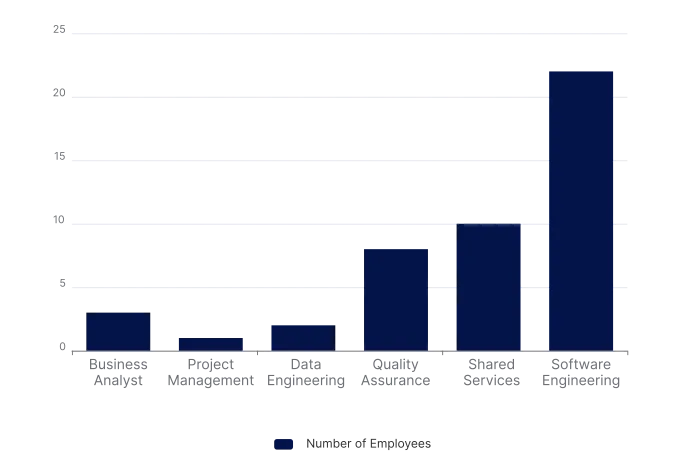
Figure 2: Bar graph illustrating the breakdown of expertise among Digiratina’s employees, showcasing the diversity of skill sets within the team.
Figure 3: Pie chart depicting the distribution of graduates and experienced professionals and more in Digiratina’s talent pool
By leveraging our top talent pool, Digiratina Technology Solutions delivers exceptional IT outsourcing services to our clients, driving innovation and success in every project.
5. Cost-Effective Solutions
With top-tier talent in Sri Lanka, you receive cost-effective solutions compared to traditional outsourcing destinations. Digiratina can optimize IT budgets without compromising on quality or employee remuneration. Significant cost savings in accessing world-class expertise and consultancy can be achieved when you work with Digiratina based in Sri Lanka.
Digiratina Technology Solutions employs several strategies to provide cost-effective solutions to our clients:
Engagement Models at Digiratina
Retainer Team
(Dedicated)
Time and
Materials Model
Fixed Price
Model
Staff
Augmentation
Retainer Team
(Dedicated)
Time and
Materials Model
Fixed Price
Model
Staff
Augmentation
Figure 4: Engagement Models at Digiratina (Please refer to Digiratina’s Engagement Models page for detailed information.)
By offering cost-effective solutions, Digiratina Technology Solutions enables our clients to achieve their business objectives within budget constraints, without compromising on quality or reliability.
6. Innovative Ecosystem
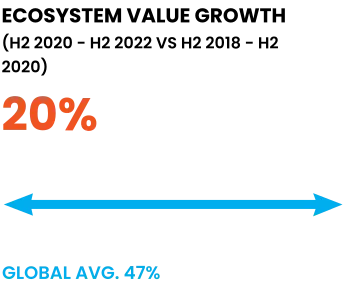
Sri Lanka is a vibrant and dynamic ecosystem that fosters innovation and entrepreneurship from the grassroots level. Bustling global tech startups founded in Sri Lanka and established IT firms like Digiratina fuel the country’s tech landscape with creativity and ingenuity. Collaborative workspaces, incubators, and accelerators provide fertile ground to exchange ideas and knowledge fostering collaboration and allowing you to tap into and use the latest trends and emerging technologies.
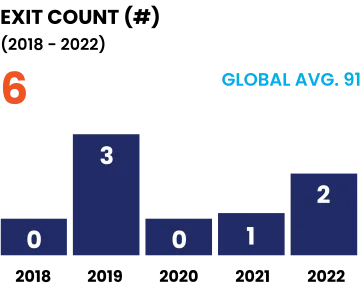
Ecosystem by the Numbers
Figure 5: This figure presents the Growth of Tech Startups in Sri Lanka, offering insights into the numerical expansion of the country’s burgeoning innovation ecosystem, as documented by Startup Genome and the Central Bank of Sri Lanka.
Data Source: Startup Genome
7. Solid Infrastructure
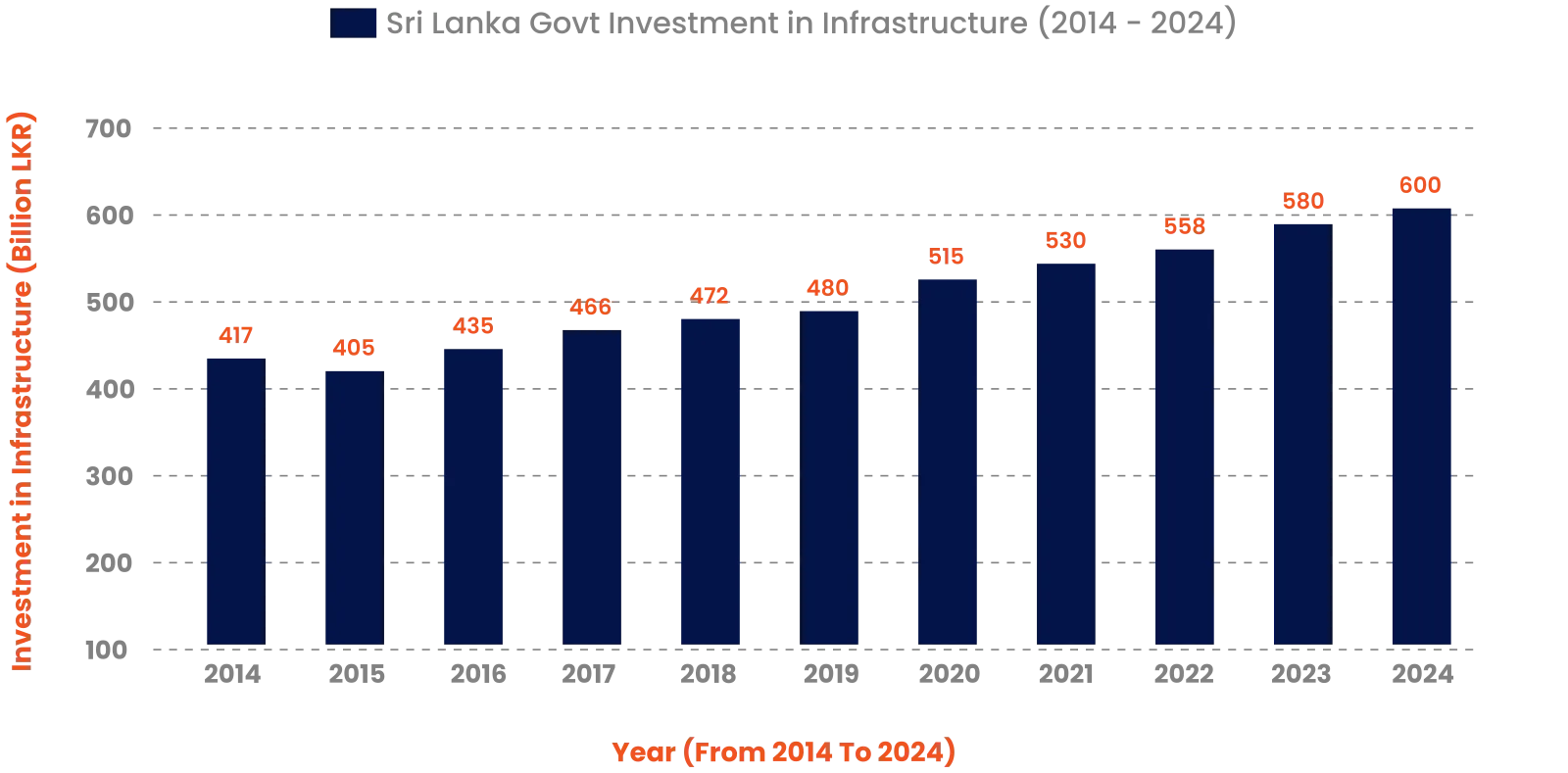
The country’s investment in infrastructure, including state-of-the-art IT parks and connectivity infrastructure, underscores its commitment to supporting the growth of the IT industry and the advancement of all professionals entering the field.
Figure 6: This figure illustrates Sri Lanka’s government investment in infrastructure from 2014 to 2024, highlighting trends in spending that reflect the government’s commitment to modernization and development. Notable investments include the establishment of IT parks and enhancements to connectivity infrastructure.
Data Source: Central Bank of Sri Lanka, CEIC Data
This sustained investment reflects Sri Lanka’s commitment to creating a conducive environment for business growth and technological advancement.
Sri Lanka holds a unique blend of talent, innovation, and cultural affinity with Western markets. Great English proficiency, coupled with a strong educational system a culture of continuous learning, and a strong focus on software quality ensures seamless communication and collaboration with clients worldwide. Whether you’re a startup looking to scale rapidly, a mid-sized enterprise seeking cost-effective solutions, or a multinational corporation aiming to leverage Sri Lanka’s strategic advantages, partnering with Digiratina promises efficiency, reliability, and value. Choose Sri Lanka as your outsourcing destination, to unlock innovation, drive growth, and stay ahead of the curve in the dynamic world of technology.
An MVP is designed to accelerate learning through real-world product validation. Its purpose is to establish whether the proposed solution addresses a genuine market requirement while controlling unnecessary development efforts.
A development company should therefore contribute to product thinking as well as engineering execution. A partner that focuses exclusively on coding may deliver functional software without sufficiently addressing user experience, product validation, technical scalability, or business objectives. Strong pre-development discussions help establish whether the company understands the problem being solved and can translate that understanding into a focused product roadmap.
1. What Experience Do You Have Building MVPs Similar to My Product?
Ask the development company to demonstrate relevant experience across comparable products, industries, technologies, or business models. A portfolio should provide evidence of actual product development capability, including the challenges addressed, technologies selected, development methodology, and outcomes achieved.
Relevant experience can shorten the discovery process because the development team may already understand common technical risks, integration requirements, security considerations, and user expectations associated with the product category. Requesting references, live products, or detailed case studies can provide stronger evidence than relying solely on marketing claims.
2. How Will You Define the Scope of My MVP?
Scope definition is one of the most important stages of MVP development. Ask how the company determines essential features, prioritizes requirements, documents exclusions, and manages changes during development.
A well-defined MVP focuses on the core functionality required to test the product proposition. Extensive feature additions can increase development complexity and dilute the purpose of early validation. Structured scoping helps establish a clear relationship between product objectives, user requirements, technical work, and delivery expectations.
3. How Will You Validate My Product Idea Before Development?
A capable MVP partner should ask questions about the target audience, customer problem, competitive environment, value proposition, and intended business model before development begins.
Validation can involve user research, competitor analysis, prototypes, usability testing, interviews, landing-page experiments, or controlled pilot programs. The objective is to reduce assumptions before substantial engineering resources are committed. MVP methodology itself is centered on obtaining practical feedback and using that learning to guide subsequent product decisions.
4. Which Technology Stack Do You Recommend and Why?
Technology selection should reflect the product’s functional requirements, expected user base, integration needs, security requirements, development roadmap, and long-term maintenance strategy.
Ask the company to explain why specific programming languages, frameworks, databases, cloud services, APIs, or AI technologies are appropriate. A credible recommendation should explain technical trade-offs and demonstrate how the selected architecture can support future iterations. Technology choices made purely according to a development team’s existing preferences can create unnecessary technical limitations.
5. Who Will Actually Work on My MVP?
The people presented during the sales process may differ from the team responsible for implementation. Ask for clarity regarding the roles, expertise, responsibilities, and availability of the developers, designers, QA specialists, project managers, and technical leads assigned to the project.
Direct access to relevant technical stakeholders can improve communication and reduce information loss during development. It is also useful to understand how the company handles team changes, knowledge transfer, documentation, and project continuity.
6. How Do You Manage Communication and Project Progress?
Clear communication is essential when product requirements evolve during MVP development. Ask which communication channels will be used, how frequently progress will be reported, how decisions will be documented, and how development demonstrations will be conducted.
A strong process should provide visibility into requirements, completed work, pending decisions, technical risks, testing status, and upcoming milestones. Regular demonstrations can help founders identify misunderstandings early and provide informed feedback throughout development.
7. How Do You Handle Changes to the MVP Scope?
Product assumptions can change as development progresses. The important consideration is how those changes are assessed and controlled.
Ask whether the company follows a formal change-management process and how modifications affect delivery schedules, development effort, and commercial terms. A structured approach allows legitimate product improvements to be evaluated without allowing uncontrolled scope of expansion to undermine the original MVP strategy.
8. What Quality Assurance Process Do You Follow?
Quality assurance should be integrated throughout MVP development instead of being treated as a final-stage activity. Ask about functional testing, usability testing, API testing, security testing, performance testing, regression testing, and device or browser compatibility.
The company should explain how defects are documented, prioritized, resolved, retested, and tracked. Strong QA practices are particularly important for MVPs intended to collect meaningful market feedback because technical defects can distort user perceptions of the underlying product concept.
9. How Will Security and Data Protection Be Addressed?
Security requirements should be considered from the architectural stage. Ask how the development company manages authentication, authorization, encryption, API security, data storage, access controls, backups, vulnerability management, and sensitive information.
For products operating in regulated industries, additional requirements may apply according to the type of information being processed, and the geographical markets served. Security should therefore be treated as an architectural responsibility that continues throughout development and post-launch operations.
10. Who Owns the Source Code and Intellectual Property?
Intellectual property ownership should be addressed in the development agreement. Ask whether the client receives ownership of the source code, design assets, technical documentation, repositories, deployment configurations, and other project deliverables.
Clarify when ownership transfers and whether any third-party libraries, licenses, proprietary components, or platform dependencies could restrict future use. Clear ownership arrangements provide founders with greater control over subsequent development, investment discussions, product expansion, or changes in technology partners.
11. What Happens After the MVP Is Launched?
An MVP launch should initiate a product learning cycle. Ask how the company supports monitoring, defect resolution, performance optimization, user feedback integration, security updates, infrastructure management, and subsequent feature development.
Post-launch support can determine whether the product can evolve efficiently after receiving market feedback. A development partner should understand that the MVP is a foundation for future iterations, not the final destination of the product.
12. How Will You Measure MVP Success?
Development should be connected to measurable product objectives. Ask the company how success will be evaluated after launch and which indicators should be monitored.
Depending on the product, relevant measures can include user engagement, retention, conversion, feature adoption, customer satisfaction, operational performance, or validated feedback. Establishing these measures before development helps align technical priorities with business outcomes.
What a Strong MVP Development Partner Should Demonstrate?
The answers to these questions should be more than technical competence. They should demonstrate how the company thinks about product strategy, risk management, communication, engineering quality, security, and future scalability.
A suitable partner should be capable of challenging assumptions constructively, identifying unnecessary complexity, explaining technical decisions clearly, and maintaining focus on the product’s core objective. The strongest engagement model connects business requirements with disciplined product discovery, UI/UX design, software engineering, quality assurance, deployment, and continuous improvement.
Cloud architecture can further support MVP evolution by enabling teams to develop, test, deploy, and scale applications according to changing requirements. AWS highlights the importance of scalable cloud services in helping MVPs evolve from early validation toward broader adoption.
Why Technical and Product Alignment Should Come First?
The lowest quotation or fastest proposed delivery should not be the primary basis for selecting an MVP development company. An MVP represents an important product decision, and poor architectural choices. Unclear ownership arrangements, weak communication, or insufficient validation can create significant downstream challenges.
The most effective selection process evaluates the development company according to its ability to understand the business problem, define a focused MVP, establish an appropriate technology foundation, maintain engineering quality, and support continuous product evolution.
Conclusion
Selecting an MVP development company is a strategic decision that can influence the direction, quality, scalability, and commercial potential of a new digital product. The right partner should demonstrate a disciplined understanding of product discovery, user requirements, technology architecture, quality assurance, security, intellectual property, communication, and post-launch development. Asking detailed questions before engagement enables founders and businesses to distinguish genuine technical capability from surface-level service claims. A successful MVP should provide a reliable environment for market learning, customer feedback, product refinement, and informed investment decisions.
At Digiratina Technology Solutions, we approach MVP development as a structured product engineering process that connects business objectives with user needs, technical architecture, design, development, quality assurance, and future scalability. Our approach focuses on defining the essential product scope, selecting appropriate technologies, establishing reliable development practices, and creating an architecture capable of supporting subsequent product evolution. From discovery and product planning through development, testing, deployment, and post-launch enhancement, our teams support each stage with an outcome-focused engineering approach. Digiratina brings this perspective to MVP engagements, helping businesses create a practical foundation for validating ideas and progressing toward scalable digital products.
Business growth increasingly depends on an organization’s ability to expand technology capabilities quickly while maintaining quality, innovation, and operational efficiency. As digital transformation accelerates across industries, companies face growing pressure to deliver software products faster, modernize existing systems, integrate emerging technologies, and respond to evolving customer expectations. Traditional hiring methods often struggle to meet these demands due to extended recruitment cycles, increasing competition for skilled developers, and the costs associated with building in-house engineering teams. Dedicated developersprovide a strategic solution by enabling organizations to access experienced technical professionals who work as an extension of their internal teams. This engagement model supports faster project execution, specialized expertise, flexible resource allocation, and improved development continuity. According to Statista, global spending on digital transformation continues to increase as organizations prioritize technology-driven growth, reinforcing the importance of scalable software development capabilities for sustained business success.
At Digiratina Technology Solutions, we help organizations build dedicated development teams that combine technical expertise, structured delivery methodologies, and secure engineering practices. Our experienced professionals work closely with clients to accelerate product development, strengthen engineering capacity, and support long-term digital transformation initiatives through flexible engagement models aligned with evolving business objectives.
Why Businesses Are Choosing Dedicated Developers?
Organizations across industries are investing in dedicated development teams because software has become central to business growth, customer engagement, operational efficiency, and innovation. Whether launching a new digital product, modernizing enterprise applications, implementing artificial intelligence solutions, or expanding cloud infrastructure, access to highly skilled developers has become a strategic requirement.
The dedicated developer model allows businesses to overcome recruitment challenges while maintaining complete visibility and control over project execution. Dedicated professionals work alongside internal teams, understand organizational goals, and contribute continuously throughout the software development lifecycle.
According to the 2024 State of Agile Report, organizations continue to prioritize agile delivery models that support collaboration, adaptability, and faster product releases. Dedicated developers naturally complement these objectives by becoming integrated members of cross-functional delivery teams.
The Strategic Advantages of Scaling with Dedicated Developers
Accelerating Product Development
Speed has become one of the strongest competitive advantages in today’s technology landscape. Organizations that introduce digital products faster are better positioned to capture market opportunities and respond to changing customer expectations.
Dedicated developers eliminate lengthy recruitment processes by providing immediate access to experienced technical professionals. This enables businesses to begin development activities sooner while maintaining engineering quality throughout the project lifecycle. At Digiratina Technology Solutions, we provide experienced developers who integrate efficiently into client projects, allowing organizations to accelerate software delivery without compromising engineering excellence or project governance.
Accessing Specialized Technical Expertise
Modern software development extends beyond programming languages. Successful digital products require expertise across cloud computing, cybersecurity, artificial intelligence, DevOps, mobile technologies, data engineering, user experience design, and quality assurance.
Building internal teams with expertise across every technology discipline can be challenging and resource intensive. Dedicated developers provide organizations with immediate access to professionals experienced in modern technology ecosystems including React, Angular, Node.js, .NET, Java, Flutter, React Native, AWS, Azure, AI technologies, enterprise software platforms, and advanced data solutions. At Digiratina, our multidisciplinary engineering teams enable businesses to access specialized technical knowledge aligned with their project requirements and long-term technology strategies.
Supporting Flexible Business Growth
Technology priorities often change throughout a project’s lifecycle. Initial development may require frontend specialists, while later phases demand DevOps engineers, cloud architects, quality assurance professionals, or artificial intelligence specialists. Dedicated development teams allow organizations to increase or adjust technical capacity according to project requirements without disrupting ongoing operations.
This flexibility improves resource utilization while supporting sustainable business expansion. At Digiratina, our scalable engagement models allow organizations to expand engineering capabilities as projects evolve, ensuring development resources remain aligned with business priorities.
Strengthening Collaboration Across Distributed Teams
Global software development increasingly relies on distributed collaboration. Successful dedicated developers function as integrated members of internal engineering teams through structured communication, transparent reporting, collaborative planning, and shared delivery objectives.
Organizations should evaluate development partners based on communication standards, project governance, documentation quality, and stakeholder engagement practices. At Digiratina Technology Solutions, we adopt agile collaboration methodologies supported by structured sprint planning, progress reporting, technical documentation, and continuous stakeholder communication to maintain complete project transparency.
Improving Development Quality
High-quality software requires disciplined engineering practices throughout the entire development of lifecycle. Dedicated developers contribute to improved software quality through structured coding standards, peer reviews, automated testing, continuous integration, performance optimization, andcomprehensive quality assurance processes.
According to the IBM Cost of a Data Breach Report 2024, the global average cost of a data breach reached USD 4.88 million, demonstrating the financial importance of secure software engineering and proactive quality management. At Digiratina, quality assurance and secure development practices are integrated into every stage of software delivery, helping organizations build reliable, scalable, and resilient digital solutions.
Reducing Recruitment Challenges
Finding experienced software engineers has become increasingly competitive across global technology markets. Internal recruitment often requires significant investment in sourcing, interviewing, onboarding, training, and long-term workforce planning.
Dedicated development partnerships significantly reduce recruitment timelines by providing immediate access to experienced professionals who are ready to contribute from project initiation. This enables businesses to focus internal resources on innovation, product strategy, and customer value creation.
At Digiratina Technology Solutions, our dedicated developer model provides organizations with carefully selected professionals possessing both technical expertise and collaborative experience across diverse industries.
Enabling Continuous Innovation
Technology evolves rapidly, requiring organizations to continuously adopt new frameworks, architectures, automation practices, and artificial intelligence capabilities.
Dedicated developers contribute valuable industry knowledge by applying current engineering practices, emerging technologies, and modern software development approaches across client projects. Continuous innovation enables businesses to improve operational efficiency, strengthen customer experiences, and maintain competitive differentiation.
Digiratina supports innovation through experienced engineering professionals, continuous learning, and technology expertise across cloud computing, AI, enterprise software development, mobile applications, and digital transformation initiatives.
Choosing the Right Dedicated Development Partner
Selecting dedicated developers involves evaluating much more than technical skills.
Organizations should assess:
Technical expertise across relevant technologies
Industry experience
Project management methodologies
Security and compliance standards
Communication practices
Resource scalability
Quality assurance processes
Post-deployment support
Long-term partnership capabilities
According to the Stack Overflow Developer Survey 2024, organizations increasingly depend on modern development frameworks, cloud technologies, and collaborative engineering environments, reinforcing the importance of selecting experienced technology partners capable of supporting evolving business requirements.
At Digiratina Technology Solutions, we combine experienced software engineers, structured governance, agile delivery methodologies, ISO/IEC 27001:2022 Information Security Management practices, ISO/IEC 27701:2019 Privacy Information Management practices, and global software delivery experience to help organizations scale engineering teams with confidence.
Conclusion
Scaling a technology team requires strategic planning, experienced engineering talent, structured collaboration, and a trusted technology partner capable of supporting business growth through every stage of software development. Dedicated developers provide organizations with the flexibility to expand technical capabilities, accelerate product delivery, strengthen software quality, and respond effectively to evolving market demands. This engagement model enables businesses to focus on innovation while maintaining access to specialized expertise, modern development practices, and scalable engineering resources. As digital transformation continues to influence every industry, organizations that invest in adaptable development strategies will be better positioned to achieve sustainable competitive advantage and long-term operational success.
At Digiratina Technology Solutions, we believe dedicated developers represent more than an external resource model. They become an integral extension of each client’s technology organization, contributing knowledge, technical excellence, and strategic insight throughout the software development lifecycle. Our dedicated engineering teams support startups, growing businesses, and global enterprises with flexible engagement models, experienced professionals, secure development practices, and disciplined project governance. By combining modern technologies, agile delivery frameworks, internationally recognized information security standards, and a commitment to engineering excellence, we help organizations scale confidently while delivering reliable digital solutions that create measurable business value.
Role Overview: We are looking for a motivated and creative Sales & Marketing Intern with a strong interest in business development, digital marketing, content creation, and client outreach. This role requires someone who can support lead generation and outreach activities, create engaging marketing content, assist with digital campaigns, and effectively communicate Digiratina’s software solutions, projects, and capabilities to a wider audience.
Key Responsibilities as an Intern Sales and Marketing:
Lead Outreach Support: Assist the business development team with prospect research, outreach, and follow-ups to help grow our network.
Website & Blog Updates: Support in publishing and updating content on our website and blog while learning the basics of SEO.
Team Collaboration: Work closely with marketing, business development, and tech teams to execute creative ideas and campaigns.
Marketing Materials: Contribute to the design of presentations, pitch decks, and marketing assets for internal and client use.
Culture & Engagement: Participate in internal initiatives and help organize fun, creative team activities.
Qualifications:
Currently pursuing or recently completed a bachelor’s degree in marketing, Business, Communications, or related field
Good English Written & Verbal Communication
Enthusiasm for learning and creativity
Prior experience or coursework in marketing or related fields is a plus
Proficiency in Digital Marketing is a plus
Why Join Us?
Gain hands-on experience managing real campaigns with measurable impact.
Enjoy creative freedom where your ideas will shape how Digiratina shows up online.
If you’re passionate about Sales, Marketing, Business Development, and building meaningful client connections, we encourage you to apply. Join our team to gain hands on experience in sales and marketing while working closely with business and technology teams, contributing to real world campaigns, and developing your skills in a growing software company.
Hiring the right software developers has become one of the most strategic decisions influencing the success of modern digital initiatives. As organizations accelerate investments in artificial intelligence, cloud computing, enterprise software, mobile applications, and digital transformation, the demand for highly skilled development talent continues to grow across every industry. At the same time, businesses face increasing pressure to control operational costs, reduce hiring timelines, and secure specialized expertise in an increasingly competitive global market. These changing dynamics have shifted hiring strategies beyond traditional recruitment models, prompting organizations to evaluate whether building an in-house development team or engaging remote developers offers the strongest long-term value.
Selecting the appropriate hiring model extends beyond filling technical vacancies. It directly influences project delivery, innovation capacity, operational scalability, team collaboration, and overall business resilience. Each approach presents unique strengths, challenges, and strategic considerations that should align with an organization’s objectives, growth stage, budget, security requirements, and product roadmap. Understanding these differences enables business leaders to make informed hiring decisions that support sustainable digital growth.
Why the Developer Hiring Model Matters?
Technology has become central to business competitiveness, making software development teams a strategic asset instead of a supporting function. Every digital product, enterprise platform, AI solution, and customer-facing application depends on developers who can build, maintain, and continuously improve technology ecosystems.
The hiring model chosen by an organization directly affects development speed, project costs, innovation, collaboration, and long-term scalability. While some organizations benefit from maintaining an internal engineering department that closely aligns with business operations, others achieve greater flexibility by accessing specialized expertise through remote development teams.
Current workforce trends further reinforce this shift. According to HackerRank’s 2025 Developer Skills Report, 79% of developers prefer hybrid or remote work arrangements, demonstrating a clear preference for flexible employment models that influence recruitment and retention strategies. Consequently, organizations evaluating in-house and remote hiring should assess both immediate project requirements and long-term business objectives before making investment decisions.
Understanding In-House Development Teams
An in-house development team consists of software engineers employed directly by the organization and working as an integrated part of its internal operations. These developers typically collaborate closely with business leaders, product managers, designers, quality assurance specialists, and operational teams, enabling continuous communication throughout the software development lifecycle.
For organizations managing highly sensitive intellectual property, proprietary technologies, or complex internal systems, in-house development often provides greater organizational visibility and direct managerial oversight.
Advantages of Hiring In-House Developers
One of the primary advantages of an in-house team is close collaboration. Developers work alongside business stakeholders daily, enabling faster communication, immediate feedback, and stronger alignment with organizational priorities.
Internal teams also develop a deeper understanding of company culture, operational processes, customer expectations, and long-term business goals. This accumulated knowledge often supports greater consistency across multiple projects and product releases.
Organizations operating within highly regulated industries may also benefit from centralized governance, stronger security controls, and simplified compliance management when development activities remain within internal infrastructure.
Additionally, internal teams often contribute beyond software delivery by participating in strategic planning, product innovation, technical leadership, and continuous organizational improvement.
Challenges of Building an In-House Team
Despite these advantages, building an internal development team presents several challenges.
Recruitment can require significant time and financial investment. Organizations must source qualified candidates, conduct technical assessments, negotiate compensation, and manage onboarding before developers become fully productive.
Operational costs also extend beyond salaries. Businesses must invest in office infrastructure, employee benefits, professional development, software licensing, hardware, security systems, and ongoing workforce management.
Another limitation is geographic access to talent. Organizations recruiting exclusively within a local market may encounter shortages of specialized skills, particularly in emerging technologies such as artificial intelligence, cloud engineering, cybersecurity, machine learning, and data science.
Scaling an internal team also becomes increasingly complex as project requirements fluctuate, making workforce expansion slower compared to more flexible hiring models.
Understanding Remote Development Teams
Remote developers work from locations outside a company’s physical office while collaborating through cloud-based development platforms, communication tools, project management systems, and secure collaboration environments.
Advancements in cloud computing, DevOps, collaborative software engineering platforms, and digital workplace technologies have enabled organizations to manage distributed development teams with high levels of productivity and operational transparency.
Remote hiring allows businesses to recruit professionals based on technical expertise instead of geographic proximity, significantly expanding available talent pools.
Advantages of Hiring Remote Developers
One of the strongest advantages of remote hiring is access to global expertise. Organizations can recruit specialists with highly specific technical skills regardless of location, improving the likelihood of finding developers whose experience closely matches project requirements.
Remote hiring also improves workforce flexibility. Businesses can rapidly scale development capacity for new initiatives, product launches, modernization projects, or temporary workloads without expanding permanent office infrastructure.
Cost optimization represents another significant advantage. Reduced expenditure on office facilities, equipment, relocation, and local recruitment enables organizations to allocate more resources toward innovation and product development. Industry comparisons indicate that remote development models can reduce overall staffing costs while maintaining strong productivity when supported by effective management practices.
Developer preferences also support this model. According to recent industry research, flexible working arrangements remain among the most valued employment benefits within the global software engineering workforce, strengthening organizations’ ability to attract experienced professionals.
Challenges of Remote Development Teams
Remote development requires disciplined communication, structured project management, and well-defined collaboration processes.
Organizations managing globally distributed teams may encounter challenges related to time zone coordination, cultural differences, communication consistency, and knowledge sharing if governance frameworks are not clearly established.
Data security also becomes increasingly important when developers access enterprise systems from multiple locations. Businesses must implement secure authentication, endpoint protection, identity management, encrypted communications, and comprehensive governance policies to protect sensitive information.
When supported by mature collaboration frameworks and strong operational governance, these challenges can be effectively managed, allowing remote teams to deliver consistent, high-quality software solutions across diverse business environments.
Why Remote Developers Have Become a Strategic Business Advantage?
Remote software development has evolved from a contingency workforce model into a long-term strategic approach adopted by organizations of every size. Advances in cloud computing, agile delivery, DevOps, secure collaboration platforms, and project management technologies have enabled distributed engineering teams to deliver software with the same level of efficiency as traditional office-based teams. Businesses are increasingly choosing remote developers to gain access to global expertise, accelerate hiring, improve scalability, and optimize technology investments without compromising engineering quality.
Access to a Broader Talent Pool
One of the strongest advantages of hiring remote developers is unrestricted access to highly skilled professionals across multiple geographical regions. Instead of depending solely on local recruitment markets, organizations can engage specialists with expertise in artificial intelligence, cloud computing, cybersecurity, enterprise software, mobile development, DevOps, quality engineering, and data analytics.
This wider talent pool enables companies to identify developers with the precise technical competencies required for complex projects while reducing recruitment delays. According to the 2025 Stack Overflow Developer Survey, software development remains a globally distributed profession with respondents representing 177 countries, demonstrating the international availability of experienced engineering talent.
At Digiratina Technology Solutions, we provide businesses with dedicated remote developers possessing extensive experience across modern technology stacks including React, Angular, .NET, Java, Node.js, Flutter, React Native, AWS, Azure, and artificial intelligence technologies.
Improved Scalability
Technology projects rarely maintain constant resource requirements throughout their lifecycle. Initial planning phases may require solution architects, followed by frontend and backend developers, quality assurance engineers, DevOps specialists, and cloud engineers during implementation and deployment.
Remote development teams provide organizations with the flexibility to increase or reduce engineering capacity according to project demands without the operational complexity associated with permanent recruitment.
This scalability supports faster product delivery while allowing organizations to optimize technology investments and respond effectively to changing business priorities.
At Digiratina, our flexible engagement models enable businesses to rapidly scale dedicated development teams while maintaining delivery consistency, engineering quality, and project governance.
Cost Optimization Without Compromising Quality
Building an internal engineering team involves considerably more than developer salaries. Organizations must account for recruitment costs, onboarding, employee benefits, office infrastructure, hardware, software licensing, training, retention initiatives, and ongoing workforce management.
Remote development partnerships reduce many of these operational expenses while providing immediate access to experienced technical professionals.
The objective is not simply reducing costs. It is maximizing engineering value by allocating investment toward innovation, product development, and business growth instead of administrative overhead.
At Digiratina Technology Solutions, our dedicated development model provides transparent engagement structures that help organizations optimize technology investment while maintaining high engineering standards.
Productivity and Collaboration in Modern Development Teams
The perception that productivity depends on physical proximity has changed significantly over the past several years. Modern collaboration platforms, agile methodologies, continuous integration pipelines, version control systems, and secure communication technologies enable distributed engineering teams to collaborate effectively regardless of location.
The 2025 Stack Overflow Developer Survey reports that remote work remains a significant part of the software industry, with the United States recording one of the highest proportions of remote developers among surveyed countries. The survey also highlights widespread adoption of collaborative development tools across engineering teams.
Successful collaboration depends on structured communication, clearly defined responsibilities, transparent reporting, documented workflows, and disciplined project management instead of geographical proximity.
At Digiratina, our remote engineering teams work through agile delivery frameworks, regular sprint planning, progress reviews, collaborative project management platforms, and continuous client engagement to maintain complete transparency throughout the software development lifecycle.
Security and Governance Across Both Models
Whether organizations employ internal developers or remote engineering teams, security remains a fundamental business requirement.
Businesses should evaluate development partners based on secure coding practices, quality assurance frameworks, intellectual property protection, access control policies, compliance standards, and information security management systems.
Remote development should never compromise data security. Well-established technology partners implement structured governance processes, secure development environments, encrypted communication channels, and internationally recognized security frameworks that protect client assets throughout project execution.
At Digiratina Technology Solutions, software security forms an integral part of every engagement. Our engineering practices are supported by internationally recognized Information Security Management and Privacy Information Management standards, helping organizations protect sensitive business information while delivering secure and reliable software solutions.
Which Hiring Model Is Right for Your Business?
The appropriate hiring strategy depends on organizational objectives, technical complexity, available resources, and long-term business plans.
Organizations may benefit from in-house developers when they require continuous product ownership, extensive organizational integration, and permanent engineering capabilities supporting proprietary platforms.
Businesses pursuing accelerated digital transformation, specialized technical expertise, faster project initiation.., or flexible resource allocation frequently achieve greater operational value through remote dedicated developers.
Many successful organizations now adopt hybrid workforce models that combine internal leadership with remote engineering specialists, enabling businesses to balance strategic oversight with global technical expertise.
Conclusion
Selecting between in-house and remote developers is not simply a recruitment decision. It is a strategic investment that influences innovation capacity, software quality, operational agility, and long-term business growth. Each hiring model offers distinct advantages depending on organizational priorities, project complexity, workforce strategy, and technology objectives. In-house teams provide deep organizational familiarity and continuous product ownership, while remote developers offer access to global expertise, flexible scalability, faster recruitment, and optimized resource utilization. As digital transformation continues to reshape industries, successful organizations increasingly evaluate development models based on measurable business outcomes, engineering excellence, security, and collaboration instead of physical location.
At Digiratina Technology Solutions, we believe every organization deserves a development strategy tailored to its unique business objectives. Our dedicated developers become trusted extensions of our clients’ engineering teams, combining technical expertise, agile delivery methodologies, secure software engineering practices, and transparent collaboration throughout the development lifecycle. By combining experienced engineering professionals, modern technology expertise, internationally recognized security practices, and a commitment to delivering measurable business value, Digiratina enables organizations to build resilient digital solutions that support long-term success in an increasingly technology-driven world.
Role Overview: We are looking for experienced BA’s with strong client-facing, ERP solutioning, and AI capabilities. This role requires someone who can engage directly with customers, understand complex business processes, design practical solutions, and effectively leverage AI tools and agents to support and accelerate system implementation.
Key Responsibilities as a Business Analyst:
Lead customer discussions, workshops, requirement gathering, and solution discovery.
Understand existing business processes, identify gaps, and translate requirements into clear functional and system requirements.
Analyze and solution ERP and enterprise business workflows across different modules.
Convert business requirements into well-structured workflows, user stories, acceptance criteria, process maps, and solution specifications.
Work closely with technical teams to translate business requirements into implementable solutions.
Effectively use AI tools, LLMs, and AI agents for requirements analysis, solution design, prototyping, documentation, and implementation support.
Create clear, structured instructions/prompts for AI agents to assist in building and configuring systems.
Validate AI-generated solutions against business requirements and ensure functional accuracy.
Act as the bridge between customers, AI-assisted development workflows, and engineering teams.
Qualifications:
4+ years of Business Analysis experience, preferably within ERP or enterprise software environments.
Strong hands-on understanding of ERP systems and end to end business processes.
Excellent customer-facing communication, stakeholder management, and workshop facilitation skills.
Strong solutioning mindset – able to move beyond documenting requirements and actively design solutions.
Very good practical knowledge of Generative AI, LLMs, AI agents, and prompt/instruction engineering.
Experience using AI-assisted tools to analyze requirements, prototype solutions, or accelerate software delivery.
Ability to understand technical concepts, APIs, integrations, databases, and system workflows.
Strong analytical, documentation, and problem-solving capabilities.
If you’re passionate about combining ERP expertise with the power of AI to drive faster, smarter enterprise solutions, we encourage you to apply. Join our team to shape how AI-assisted delivery transforms the way businesses implement and scale their systems.
In today’s rapidly evolving digital landscape, businesses require reliable technology capabilities to build scalable applications, accelerate product innovation, and maintain a competitive advantage. Hiring dedicated developers has become a strategic approach for organizations seeking specialized technical expertise, flexible team structures, and faster development cycles without the limitations of traditional recruitment models. According to Statista, global spending on digital transformation technologies and services continues to grow significantly, reflecting the increasing demand for skilled software development resources. Businesses must therefore ask the right questions before engaging with a dedicated development provider to ensure alignment with their goals, technical requirements, and expected outcomes.
At Digiratina Technology Solutions, we help organizations build high-performing dedicated development teams supported by experienced engineers, structured delivery processes, and industry-focused expertise. Our approach combines technical excellence, agile methodologies, quality assurance practices, and secure development frameworks to deliver reliable software solutions aligned with business objectives.
1. What Experience Does the Development Team Have with Similar Projects?
Understanding a developer’s previous experience is one of the most important steps before establishing a partnership. Businesses should evaluate whether the development team has successfully delivered projects with similar complexity, technology requirements, industry standards, and business objectives. Experience within a relevant domain helps developers understand potential challenges, identify effective solutions, and reduce unnecessary development risks.
Reviewing previous case studies, client success stories, technical portfolios, and project outcomes provides valuable insights into the team’s capabilities. Companies should examine whether the developers have worked on scalable applications, enterprise platforms, mobile solutions, cloud-based systems, artificial intelligence implementations, or software modernization initiatives.
At Digiratina, we support organizations across different industries by providing dedicated development teams with expertise in web development, mobile application development, cloud solutions, artificial intelligence, data engineering, and enterprise software development. Our engineers bring practical experience across multiple technology ecosystems, allowing businesses to access specialized skills required for their unique digital initiatives.
2. What Technologies and Development Frameworks Do the Developers Specialize In?
Technology expertise directly impacts the quality, scalability, and future maintainability of a software solution. Before hiring dedicated developers, businesses should understand whether the team possesses strong knowledge of the required programming languages, frameworks, databases, cloud platforms, and development tools.
Organizations should evaluate technical proficiency across areas such as frontend frameworks, backend architectures, mobile development platforms, cloud infrastructure, cybersecurity practices, database management, and emerging technologies. The selected development team should demonstrate the ability to recommend suitable technologies based on project requirements instead of applying the same approach to every solution.
At Digiratina, our dedicated developers work with advanced technology stacks including React, Angular, Node.js, .NET, Java, PHP, Flutter, React Native, AWS, Azure, artificial intelligence frameworks, and modern data platforms. We focus on selecting technologies based on business goals, scalability requirements, performance expectations, and long-term maintenance considerations.
3. How Does the Development Team Manage Communication and Collaboration?
Effective communication is essential for successful collaboration between businesses and dedicated development teams. Before hiring developers, organizations should understand the communication channels, reporting structures, meeting schedules, and collaboration methods followed throughout the project’s lifecycle.
A reliable development partner should provide transparent updates regarding project progress, technical challenges, timelines, and upcoming milestones. Businesses should also evaluate the team’s ability to communicate technical concepts clearly with both technical and non-technical stakeholders. Poor communication can result in misunderstandings, delayed deliveries, and misalignment between business expectations and technical implementation.
At Digiratina, we follow organized communication practices supported by agile methodologies, regular progress discussions, project management tools, and transparent reporting mechanisms. Our dedicated teams collaborate closely with clients to maintain visibility throughout the development journey and ensure that technical decisions support business priorities.
4. What Development Methodologies Does the Team Follow?
The development methodology followed by a dedicated team influences project flexibility, delivery efficiency, and overall quality. Businesses should ask potential development partners about their approach to planning, execution, testing, feedback management, and continuous improvement.
Agile development methodologies are widely adopted because they enable teams to work through iterative development cycles, incorporate feedback effectively, and adapt to changing business requirements. Companies should also understand how developers manage sprint planning, backlog prioritization, code reviews, testing procedures, and release management. A structured development process helps minimize risks and improves project predictability.
At Digiratina, we utilize agile practices to create transparent and collaborative development environments. Our teams focus on continuous improvement, regular stakeholder engagement, quality validation, and efficient delivery processes to support successful software development outcomes.
5. How Does the Team Ensure Software Quality and Security?
Software quality and security are critical considerations when selecting dedicated developers. Businesses should evaluate whether the development team follows established quality assurance procedures, security guidelines, code review practices, and testing frameworks.
A professional development partner should integrate testing throughout the development lifecycle instead of treating quality checks as a final stage. Businesses should ask about automated testing, performance testing, security assessments, vulnerability management, and compliance practices.
Security has become a major priority as organizations manage increasing volumes of sensitive business and customer information. According to IBM’s Cost of a Data Breach Report 2024, the global average cost of a data breach reached USD 4.88 million, highlighting the importance of proactive security measures throughout software development.
At Digiratina, security and quality are integrated into every stage of development. We follow disciplined engineering practices supported by quality assurance processes, secure coding standards, and internationally recognized information security frameworks including ISO/IEC 27001:2022 and privacy management practices aligned with ISO/IEC 27701:2019. Our teams help businesses develop secure, reliable, and scalable digital solutions.
6. How Are Developers Selected, Evaluated, and Assigned to Projects?
The quality of a dedicated development team depends significantly on the developer selection process followed by the technology partner. Businesses should understand how developers are screened, evaluated, and matched with specific project requirements before starting a collaboration.
Organizations should ask whether developers undergo technical assessments, coding evaluations, architectural discussions, and practical project reviews before being assigned. This ensures that selected professionals have the required expertise to contribute effectively from the beginning of the engagement.
A dedicated development model provides businesses with access to specialized professionals without requiring lengthy internal recruitment processes. However, the success of this approach depends on whether the development partner maintains a strong talent acquisition and evaluation framework.
At Digiratina Technology Solutions, we carefully assess developers based on technical capabilities, project experience, domain knowledge, and collaboration skills. Our teams are structured to align the right professionals with each client’s technical requirements, ensuring businesses receive dedicated resources capable of supporting their product vision and development objectives.
7. Can the Development Team Scale According to Future Business Requirements?
Business requirements frequently change as products evolve, markets expand, and customer expectations increase. Before hiring dedicated developers, organizations should evaluate whether the technology partner can scale out resources according to future needs.
A reliable development partner should have the ability to increase or reduce team capacity based on project phases, technical priorities, and business growth. This flexibility allows companies to maintain development momentum during periods of expansion while optimizing resource allocation during lower-demand periods.
At Digiratina, we provide scalable development teams that allow businesses to adjust technical resources based on project requirements. Whether organizations require additional developers, specialized engineers, quality assurance professionals, or technical expertise for specific phases, our flexible engagement models support long-term digital transformation goals.
8. What Is the Team’s Approach to Project Management and Delivery Tracking?
Effective project management ensures that software development activities remain organized, measurable, and aligned with business expectations. Before selecting dedicated developers, companies should understand how projects are planned, monitored, and delivered.
Businesses should ask about project management tools, milestone tracking methods, risk management processes, documentation standards, and performance reporting practices. Clear project visibility allows stakeholders to monitor progress, identify potential challenges early, and make informed decisions throughout development. This creates accountability and supports consistent project execution.
At Digiratina, our project management approach combines agile practices with transparent reporting and collaborative planning. Our teams use structured workflows to manage requirements, track progress, conduct reviews, and maintain alignment between technical execution and business objectives. This approach enables clients to maintain visibility and confidence throughout every stage of the development lifecycle.
9. How Does the Team Handle Intellectual Property Protection and Data Security?
Intellectual property protection is an essential consideration when outsourcing software development services. Businesses must ensure that their source code, product concepts, business information, and confidential data remain protected throughout the engagement.
Before hiring dedicated developers, organizations should discuss confidentiality agreements, ownership rights, data access controls, secure development environments, and compliance practices. A trustworthy technology partner should have clear policies that define intellectual property ownership and protect client assets.
Data security has become increasingly important as cyber threats continue to affect organizations worldwide. The World Economic Forum’s Global Cybersecurity Outlook highlights the growing complexity of cybersecurity challenges faced by businesses, emphasizing the importance of strong security frameworks.
At Digiratina, we prioritize confidentiality, secure engineering practices, and responsible data management. Our processes are designed to support secure collaboration while protecting client information and intellectual property. We follow internationally recognized security and privacy standards to maintain a trusted development environment for our global clients.
10. What Support and Maintenance Services Are Available After Development?
Software development does not end after product deployment. Applications require continuous monitoring, updates, performance improvements, security enhancements, and technical support to remain effective over time.
Businesses should ask dedicated development providers about post-launch support services, maintenance agreements, bug resolution processes, application monitoring, and future enhancement capabilities. A long-term technology partner should have the ability to support the complete software lifecycle.
Regular maintenance helps organizations improve application performance, adapt to technology changes, and address evolving user expectations. This approach contributes to stronger product stability and longer-term business value.
At Digiratina, we provide ongoing technical support and maintenance services designed to help businesses maximize the value of their software investments. Our teams assist clients with application improvements, system optimization, technology upgrades, and continuous enhancements to support sustainable digital growth.
11. How Transparent Are the Pricing and Engagement Model?
Understanding the pricing structure is an important step before hiring dedicated developers. Businesses should evaluate whether the engagement model provide clear information about development costs, resource allocation, timelines, and additional requirements.
A professional technology partner should provide transparent pricing models without hidden charges. Organizations should understand whether they are selecting a full-time dedicated team, project-based engagement, or flexible resource augmentation model. Clear financial planning allows businesses to manage technology investments effectively while ensuring alignment between expected outcomes and available budgets.
At Digiratina, we provide flexible engagement models designed around different business requirements. Our transparent approach helps organizations understand resource planning, project scope, and investment expectations while receiving access to experienced development professionals.
12. Does the Team Have Experience with Cloud Technologies and Modern Infrastructure?
Modern software applications require reliable infrastructure, scalability, and efficient deployment processes. Businesses should evaluate whether dedicated developers have experience with cloud platforms, DevOps practices, database management, and infrastructure optimization.
Cloud expertise enables organizations to build applications that can handle changing user demands while improving reliability and operational efficiency. Developers should understand cloud architecture, security configurations, deployment automation, and performance monitoring.
At Digiratina, our developers work with leading cloud platforms including AWS and Azure to help businesses create scalable and secure applications. Our expertise extends across cloud-native development, system modernization, and infrastructure optimization to support evolving technology requirements.
13. How Does the Team Manage Requirements and Changing Business Needs?
Software projects often evolve as businesses gather user feedback, analyze market trends, and refine their objectives. Companies should understand how a dedicated development team manages changing requirements without affecting quality and delivery timelines. A capable development partner should have processes for requirement analysis, impact assessment, prioritization, and implementation planning. Effective requirement management ensures that development efforts remain aligned with business goals.
At Digiratina, we collaborate closely with clients to understand changing requirements and deliver solutions that adapt to evolving business needs. Our teams combine technical expertise with strategic consultation to create solutions that support long-term objectives.
14. What Client References and Success Stories Can the Team Provide?
Client references and previous project outcomes provide valuable evidence of a development partner’s reliability and expertise. Businesses should review testimonials, case studies, completed projects, and measurable results before making a decision. Successful partnerships demonstrate the provider’s ability to manage technical challenges, deliver quality solutions, and maintain strong client relationships.
At Digiratina, we highlight our successful collaborations across industries through practical solutions, long-term partnerships, and technology-driven outcomes. Our experience working with organizations globally reflects our commitment to delivering dependable software development services.
15. Why Should Businesses Choose Dedicated Development Partner?
Selecting a dedicated development partner requires evaluating technical expertise, reliability, communication practices, security standards, and long-term collaboration potential. Businesses should choose providers that understand their objectives and demonstrate the ability to contribute meaningful value throughout the software development journey. The right partner should act as a technology extension of the organization, supporting innovation, improving operational efficiency, and helping businesses achieve measurable digital outcomes.
At Digiratina Technology Solutions, we combine experienced engineering teams, structured delivery methodologies, security-focused practices, and industry knowledge to help organizations develop scalable digital solutions. Our dedicated development services are designed to support startups, enterprises, and technology-driven businesses seeking reliable expertise for their software initiatives.
Conclusion
Hiring dedicated developers is a strategic decision that can significantly influence the success of digital initiatives. Organizations must carefully evaluate technical capabilities, development methodologies, security practices, communication processes, and long-term partnership potential before selecting a technology provider. A dedicated development team provides businesses with access to specialized skills, improved flexibility, and the ability to accelerate software innovation.
At Digiratina, we support businesses by providing dedicated development teams equipped with modern technology expertise, industry experience, and a strong focus on secure software delivery. Our approach combines technical excellence with business understanding to help organizations transform ideas into scalable digital solutions. Through agile development practices, quality assurance frameworks, and international security standards, we help clients build technology products that create lasting value. By choosing Digiratina as a dedicated development partner, businesses gain access to a trusted technology team focused on innovation, reliability, and successful digital transformation.
A B2B website has evolved beyond its traditional role as a digital company profile. Today, it functions as a strategic sales enablement platform that influences buyer decisions, supports lead generation, educates prospects, and accelerates the sales cycle. Modern B2B buyers conduct extensive independent research before engaging with a sales representative, making the corporate website one of the most influential touchpoints throughout the buying journey. According to Gartner, B2B buyers spend only a small portion of their purchasing journey interacting directly with suppliers, with much of their decision-making occurring through independent digital research. This shift has increased the importance of websites that provide valuable information, build credibility, and guide visitors toward informed purchasing decisions.
Organizations that structure their websites around customer needs, business objectives, and sales enablement strategies strengthen conversion rates while improving marketing and sales alignment. At Digiratina, we develop intelligent B2B websites that combine user experience, strategic content, modern technologies, and data-driven optimization to help organizations generate qualified leads, nurture buyer confidence, and achieve measurable business growth.
Why Website Structure Matters for Sales Enablement?
Sales enablement focuses on equipping potential customers with the information, resources, and confidence required to make informed purchasing decisions. A strategically structured B2B website supports this objective by delivering relevant content throughout every stage of the buyer journey. Modern buyers expect immediate access to product information, service capabilities, industry expertise, pricing guidance, customer success stories, technical documentation, and educational resources before contacting a sales team.
Research from Gartner indicates that buyers increasingly prefer self-service digital experiences during complex purchasing decisions. Organizations that provide comprehensive digital experiences improve customer engagement while enabling sales teams to focus on qualified opportunities with higher conversion potential. A well-structured website therefore becomes an active contributor to business development by attracting prospects, educating decision-makers, establishing credibility, and generating sales-qualified leads.
Essential Components of a Sales-Enabled B2B Website
1. A Clear Value Proposition on the Homepage
The homepage serves as the primary introduction to an organization’s expertise and business value. Visitors should immediately understand the company’s capabilities, target industries, service offerings, competitive advantages, and customer outcomes within the first few seconds of arriving on the website.
A strong value proposition communicates business benefits through concise messaging supported by clear calls-to-action, trust indicators, customer success metrics, certifications, and industry experience. An effective homepage reduces visitor uncertainty while encouraging further exploration throughout the website.
2. Service Pages That Address Business Challenges
Many B2B websites describe services from the organization’s perspective instead of addressing customer challenges.
High-performing service pages explain how specific solutions resolve operational problems, improve efficiency, reduce costs, strengthen security, or accelerate business growth.
Each service page should clearly communicate:
Business challenges addressed
Solution overview
Key features and capabilities
Industry applications
Business benefits
Technology expertise
Customer outcomes
Frequently asked questions
This structure enables buyers to evaluate solutions based on business value instead of technical specifications alone.
3. Industry-Specific Solution Pages
Decision-makers prefer working with technology partners that understand their industry’s operational challenges. Industry-focused landing pages demonstrate domain expertise while improving search engine visibility for industry-specific keywords.
Dedicated pages for healthcare, finance, manufacturing, logistics, retail, education, construction, government, and professional services illustrate how technology solutions align with unique regulatory requirements, operational processes, and customer expectations. These pages strengthen credibility while increasing relevance for targeted audiences.
4. Educational Content That Supports Buyer Research
Modern B2B purchasing decisions involve extensive research before vendor engagement. Educational resources including blogs, whitepapers, case studies, implementation guides, technical documentation, industry reports, webinars, and frequently asked questions help buyers understand complex business challenges while evaluating available solutions.
According to Demand Gen Report, B2B buyers consistently consume multiple pieces of content throughout their purchasing journey before initiating conversations with vendors. Educational content establishes organizational authority while positioning the company as a trusted advisor instead of solely a service provider.
5. Strong Trust Signals Throughout the Website
Trust remains one of the most influential factors affecting B2B purchasing decisions. Visitors seek evidence that demonstrates technical capability, industry experience, security standards, and successful project delivery.
Effective trust signals include:
Client testimonials
Customer success stories
Industry certifications
Technology partnerships
Awards and recognitions
Case studies
Years of industry experience
Security and compliance certifications
Client logos
Quantifiable project outcomes
These credibility indicators reduce perceived purchasing risk while strengthening buyer confidence during evaluation.
6. Conversion-Focused Website Navigation
An effective B2B website should guide visitors through a structured buying journey. Every page should encourage users to take the next logical step, whether exploring services, downloading resources, requesting a consultation, or contacting the sales team.
Navigation should remain intuitive, consistent, and organized according to user priorities instead of internal company structures. Clear menu categories, logical page hierarchies, internal linking, and search functionality enable visitors to locate relevant information efficiently. Well-structured navigation reduces friction throughout the buyer journey while increasing engagement and conversion opportunities.
7. Strategic Calls-to-Action That Support Sales Conversations
Calls-to-action (CTAs) play a critical role in converting website visitors into qualified sales opportunities.
Instead of relying solely on generic contact forms, organizations should offer multiple engagement opportunities that align with different stages of the buyer journey.
Examples include:
Schedule a consultation
Request a product demonstration
Download an industry guide
Access a case study
Speak with a technology expert
Request a project assessment
Subscribe to industry insights
Explore implementation services
Well-positioned CTAs encourage meaningful interactions while supporting lead qualification and sales pipeline development.
8. CRM Integration and Marketing Automation
A sales-enabled website should function as an integrated component of the organization’s sales ecosystem. Connecting the website withCustomer Relationship Management (CRM) platforms and marketing automation tools enables organizations to capture leads, monitor visitor behavior, automate follow-up communications, score prospects, and support personalized engagement throughout the sales cycle.
Website forms, downloadable resources, consultation requests, and newsletter subscriptions should automatically synchronize with CRM systems, enabling sales teams to respond quickly with relevant information. This integration improves collaboration between marketing and sales while increasing operational efficiency.
9. AI-Powered Personalization and Customer Insights
Artificial Intelligence is transforming how B2B websites engage prospective customers. AI-powered recommendation engines, intelligent chatbots, personalized content delivery, predictive analytics, and behavioral analysis help organizations create highly relevant digital experiences based on visitor interests and engagement history.
Instead of presenting identical content to every visitor, AI enables websites to recommend industry-specific solutions; relevant case studies, educational resources, and service offerings aligned with each visitor’s requirements. These personalized experiences improve engagement, increase lead quality, and strengthen customer confidence throughout the decision-making process.
10. Mobile Responsiveness and Website Performance
Decision-makers increasingly access B2B websites using smartphones and tablets throughout their purchasing journey. A mobile-responsive website ensures consistent user experiences across all devices while supporting accessibility, usability, and search engine visibility. Performance optimization also remains essential. Fast-loading pages, optimized images, efficient code, secure hosting, and reliable infrastructure improve user satisfaction while reducing abandonment rates.
Search engines prioritize websites that deliver strong user experiences, making performance optimization an important factor for both customer engagement and search visibility. Organizations investing in responsive design and website performance create stronger digital experiences that support higher conversion rates and long-term business growth.
Developing a high-performing B2B website requires more than an attractive visual design. It demands strategic planning, user experience expertise, search engine optimization, sales enablement, technology integration, and continuous optimization to support measurable business outcomes.
At Digiratina Technology Solutions, we design and develop intelligent B2B websites that function as powerful business development platforms. Our approach focuses on aligning website architecture with business objectives, enabling organizations to attract qualified prospects, strengthen brand credibility, generate high-quality leads, and accelerate sales opportunities. From custom website development and enterprise portals to digital transformation initiatives and AI-powered web experiences, every solution is engineered with scalability, security, performance, and long-term business growth as fundamental priorities.
Conclusion
A well-structured B2B website has become one of the most valuable assets for enabling sales, strengthening customer engagement, and supporting sustainable business growth. Modern buyers expect immediate access to accurate information, industry expertise, customer success stories, educational resources, and clear pathways for engaging with solution providers. Sales enablement begins long before the first conversation with a sales representative. It starts with a website that educates prospective buyers, answers critical questions, demonstrates expertise, and provides the confidence required to move forward. As digital buying behavior continues to evolve, businesses that continuously optimize their websites will strengthen competitive positioning while improving lead generation, customer acquisition, and long-term revenue growth.
We believe every B2B website should serve as a strategic growth platform that empowers both marketing and sales teams. Our experienced professionals collaborate closely with organizations to design intelligent digital experiences that combine customer-focused design, advanced technologies, enterprise integration, search engine optimization, AI-powered capabilities, and measurable business outcomes. Through our expertise in digital transformation, custom software engineering, website development, and sales enablement strategies, Digiratina delivers scalable web solutions that help organizations build stronger customer relationships, improve operational efficiency, and achieve sustainable growth within increasingly competitive digital markets.
Artificial Intelligence (AI) has become one of the most transformative technologies influencing modern application development. Across industries including healthcare, finance, retail, logistics, manufacturing, education, and professional services, AI-powered applications are enhancing user experiences, improving operational efficiency, and enabling businesses to make faster, data-driven decisions. Mobile and web applications are evolving from static software solutions into intelligent digital platforms capable of learning user behavior, automating complex workflows, delivering personalized experiences, and supporting predictive decision-making.
According to Statista, the global Artificial Intelligence market is projected to exceed US$243 billion in 2025, while Grand View Research forecasts the AI market to continue expanding at a compound annual growth rate exceeding 35% through the coming decade. These growth trends demonstrate that AI has become a strategic investment for organizations seeking long-term digital competitiveness. For businesses developing next-generation applications, understanding emerging AI technologies has become essential for delivering scalable, intelligent, and future-ready digital products. At Digiratina Technology Solutions, we leverage advanced AI technologies to build innovative applications that enable organizations to accelerate digital transformation while creating measurable business value.
Why Emerging AI Technologies Are Transforming Application Development?
Traditional software applications execute predefined instructions based on fixed programming logic. Modern AI-powered applications continuously analyze data, recognize patterns, automate decisions, personalize user interactions, and improve performance through continuous learning.
This evolution enables organizations to develop intelligent applications capable of adapting to changing customer expectations while improving operational efficiency across multiple business functions.
According to McKinsey & Company, organizations increasingly adopt artificial intelligence to automate business operations, improve customer engagement, optimize workflows, and generate competitive advantages through intelligent decision-making.
Emerging AI Technologies Shaping Application Development
1. Generative Artificial Intelligence
Generative artificial intelligence has rapidly become one of the most influential innovations in modern software development. Powered by Large Language Models (LLMs), generative AI enables applications to create human-like text, images, code, audio, video, and digital content using natural language prompts.
Businesses are integrating generative AI into customer service platforms, document generation systems, software development tools, knowledge management solutions, virtual assistants, and enterprise productivity applications.
Within application development, generative AI accelerates software engineering by assisting developers with code generation, documentation, debugging, automated testing, and technical recommendations. It also enables businesses to deliver intelligent customer interactions through conversational interfaces that provide personalized and context-aware responses. As organizations continue expanding AI adoption, generative AI is becoming a foundational capability for creating intelligent digital experiences.
2. AI-Powered Personalization Engines
Customer expectations continue to shift toward highly personalized digital experiences. AI-powered personalization engines analyze customer preferences, browsing behavior, purchasing patterns, location data, application usage, and historical interactions to deliver customized recommendations in real time.
Streaming platforms recommend entertainment content based on viewing history, retail applications provide personalized product recommendations, banking applications deliver customized financial insights, and healthcare applications generate individualized wellness recommendations.
These intelligent personalization capabilities significantly improve customer engagement, increase application retention, and strengthen long-term customer relationships. Organizations investing in personalization technologies create applications that deliver greater value throughout every stage of the customer journey.
3. Predictive Analytics and Machine Learning
Predictive analytics enables applications to anticipate future outcomes using historical and real-time data. Machine Learning algorithms continuously identify patterns, evaluate business trends, detect anomalies, forecast demand, estimate risks, and generate intelligent recommendations that improve operational decision-making.
Industries including finance, logistics, healthcare, insurance, manufacturing, and retail increasingly depend on predictive analytics to optimize inventory planning, forecast customer demand, identify fraudulent transactions, reduce equipment failures, and improve resource allocation.
Applications equipped with predictive intelligence help organizations transition from reactive decision-making toward proactive operational management supported by continuously evolving data insights.
4. Natural Language Processing (NLP)
Natural language processing enables applications to understand, interpret, and generate human language with increasing accuracy. Modern NLP technologies support conversational chatbots, multilingual translation, intelligent document search, sentiment analysis, automated summarization, speech recognition, voice assistants, and enterprise knowledge management systems.
Businesses increasingly deploy NLP-powered virtual assistants to improve customer support while reducing operational workloads. Within enterprise environments, NLP simplifies document processing, accelerates information retrieval, and improves communication across multilingual workforces. As language models continue advancing, Natural Language Processing is becoming a critical component of intelligent business applications.
5. Edge AI and On-Device Intelligence
As mobile applications become increasingly intelligent, organizations are moving AI processing closer to the user through Edge AI. Unlike traditional cloud-based AI models that depend on continuous internet connectivity, Edge AI performs data processing directly on smartphones, tablets, wearable devices, and Internet of Things (IoT) devices.
Processing AI models locally significantly reduces response times while improving application reliability, operational efficiency, and user privacy. Applications can continue functioning even with limited network connectivity, making Edge AI particularly valuable for healthcare monitoring, industrial automation, autonomous vehicles, retail operations, smart manufacturing, and field service applications.
Advancements in mobile processors, dedicated AI accelerators, and optimized machine learning frameworks have made Edge AI increasingly practical for enterprise applications. Organizations adopting Edge AI gain faster decision-making capabilities, improved customer experiences, and greater operational resilience.
6. AI Agents and Autonomous Applications
AI agents represent one of the most significant developments, shaping the future of application development. Unlike conventional AI models that respond only to individual user requests, AI agents can understand objectives, execute multi-step tasks, interact with multiple systems, retrieve information, make contextual decisions, and continuously adapt based on changing inputs.
Modern enterprise applications increasingly incorporate AI agents to automate customer service, sales support, IT operations, workflow management, scheduling, financial reporting, software testing, and business process automation.
According to Gartner, agentic AI is expected to become one of the defining technology trends over the coming years as organizations seek greater levels of operational automation and intelligent decision-making. Businesses adopting AI agents improve productivity while enabling employees to focus on strategic initiatives that require human expertise.
7. Explainable AI (XAI) and Responsible Artificial Intelligence
As AI systems become more sophisticated, transparency and accountability have become essential considerations for organizations developing intelligent applications. Explainable AI enables businesses to understand how AI models generate recommendations, predictions, and automated decisions. This capability improves regulatory compliance, strengthens stakeholder confidence, and supports responsible AI governance.
Industries including healthcare, banking, insurance, and government increasingly require explainable AI to ensure fairness, reduce algorithmic bias, maintain ethical standards, and satisfy regulatory obligations.
Responsible AI frameworks also emphasize privacy protection, secure data management, fairness, model monitoring, and continuous performance evaluation. Organizations adopting these practices build trustworthy AI applications capable of supportinglong-term digital transformation.
Why Businesses Choose Digiratina Technology Solutions for AI-Powered App Development
Artificial Intelligence delivers maximum business value when combined with strong engineering expertise, scalable software architecture, secure development practices, and deep industry knowledge. Developing intelligent applications requires far more than integrating AI models into existing software. Every solution should align with business objectives, operational workflows, customer expectations, regulatory requirements, and long-term growth strategies.
At Digiratina Technology Solutions, we specialize in designing and developing next-generation AI-powered applications that combine innovation with enterprise-grade engineering excellence. From AI-powered enterprise applications and intelligent customer engagement platforms to predictive analytics systems, automation solutions, mobile applications, and digital transformation initiatives, our development approach focuses on scalability, security, performance, usability, and measurable business outcomes. Every solution is engineered to support sustainable growth while enabling organizations to remain competitive within an increasingly AI-driven digital economy.
Conclusion
Artificial Intelligence continues to redefine the future of application development by introducing technologies capable of transforming how organizations operate, innovate, and engage customers. Emerging technologies extend beyond improving operational efficiency by creating opportunities for personalized customer experiences, intelligent automation, enhanced decision-making, stronger security, and sustainable business growth. Organizations that strategically invest in AI-driven application development position themselves to improve competitiveness, accelerate innovation, and respond more effectively to changing market expectations. As AI technologies continue advancing, businesses that embrace responsible implementation, scalable architecture, and continuous innovation will be better equipped to create future-ready digital products that deliver measurable long-term value.
At Digiratina Technology Solutions, we believe artificial intelligence should serve as a strategic enabler of business transformation through practical innovation, engineering excellence, and measurable outcomes. Our experienced teams collaborate closely with organizations to design customized AI-powered applications that address real business challenges while supporting long-term digital growth. Through our expertise in AI-powered software development and digital transformation, Digiratina empowers organizations to confidently embrace emerging technologies while building intelligent applications that create sustainable competitive advantage in an increasingly connected digital world.
Role Overview: As an Intern DevOps Engineer at Digiratina Technology Solutions, you will gain hands-on experience in cloud infrastructure, deployment, automation, and DevOps practices. You will support the DevOps team in managing AWS infrastructure, CI/CD pipelines, and deployment activities while learning to troubleshoot technical issues and contribute to reliable, secure, and efficient software delivery.
Key Responsibilities as an Intern DevOps Engineer:
Assist the DevOps team in managing and maintaining AWS cloud infrastructure.
Support development and QA teams with basic infrastructure and deployment-related tasks.
Assist in provisioning and configuring AWS resources under the guidance of senior team members.
Learn and contribute to Infrastructure as Code (IaC) using Terraform, AWS CloudFormation, or similar tools.
Assist in maintaining CI/CD pipelines and supporting application deployments.
Monitor AWS resources, applications, and logs and escalate issues when required.
Assist with troubleshooting infrastructure and deployment-related issues.
Support basic AWS IAM, security groups, networking, and access-management activities.
Assist with monitoring, logging, backups, and other operational activities.
Learn and follow cloud security and operational best practices.
Assist in documenting infrastructure configurations, deployment procedures, and troubleshooting steps.
Participate in incident investigations and technical discussions with the DevOps team.
Continuously learn AWS, DevOps, automation, and cloud infrastructure technologies.
Qualifications:
Currently pursuing or recently completed a degree/diploma in Computer Science, Information Technology, Software Engineering, or a related field.
Basic understanding of cloud computing and AWS concepts.
Familiarity with AWS services such as EC2, VPC, IAM, S3, CloudWatch, Lambda, and related services is an advantage.
Basic understanding of Linux operating systems and command-line tools.
Basic knowledge of Git and version control.
Basic understanding of networking concepts such as IP addresses, DNS, ports, firewalls, and security groups.
Familiarity with scripting languages such as Bash, Python, or similar is an advantage.
Basic understanding of CI/CD concepts is an advantage.
Exposure to Terraform, CloudFormation, Docker, or other DevOps tools is an added advantage.
Strong problem-solving and analytical skills.
Good communication and documentation skills.
Strong willingness to learn and develop technical skills.
Ability to work effectively as part of a collaborative Agile team.
If you are passionate about cloud technologies, automation, and infrastructure optimization, we encourage you to apply. Join our growing DevOps team to work on modern cloud solutions, enhance deployment processes, and build scalable, secure, and reliable systems while advancing your career in cloud engineering.
Role Overview: As an Associate DevOps Engineer at Digiratina Technology Solutions, you will support the implementation and maintenance of secure, scalable, and highly available AWS cloud infrastructure. Working closely with development teams, you will contribute to cloud automation, CI/CD pipelines, and infrastructure optimization to ensure reliable application deployments.
Key Responsibilities as an Associate DevOps Engineer:
Assist in designing, provisioning, and maintaining secure, scalable, and highly available AWS cloud infrastructure.
Provision and manage AWS resources using Infrastructure as Code (IaC) practices.
Develop, maintain, and improve Terraform, CloudFormation, or similar IaC configurations.
Build, maintain, and troubleshoot CI/CD pipelines for automated application deployments.
Work closely with development teams to understand and support infrastructure and deployment requirements.
Monitor cloud infrastructure, applications, and services and troubleshoot operational issues.
Investigate infrastructure and deployment incidents and contribute to root-cause analysis.
Implement and maintain AWS security best practices, including IAM, security groups, network controls, and access management.
Support AWS networking components including VPCs, subnets, routing, load balancers, DNS, and connectivity.
Maintain operational tooling for deployment, monitoring, logging, alerting, and infrastructure analysis.
Support containerized workloads using technologies such as Docker and Amazon ECS.
Assist with infrastructure cost monitoring, optimization, and resource utilization improvements.
Maintain cloud architecture documentation, deployment guides, runbooks, and operational procedures.
Participate in incident response, system maintenance, and on-call or support activities when required.
Collaborate with development, QA, security, and other cross-functional teams to improve system reliability and deployment efficiency.
Continuously evaluate and adopt DevOps and cloud best practices to improve automation, reliability, and operational efficiency.
Qualifications:
1+ years of hands-on experience working with AWS cloud infrastructure and DevOps practices.
Hands-on experience with AWS services such as VPC, EC2, IAM, Security Groups, ECS, CloudFront, Route 53, Lambda, Aurora/RDS, S3, CloudWatch, and related services.
Practical experience with Infrastructure as Code using Terraform, AWS CloudFormation, or similar tools.
Experience building and maintaining CI/CD pipelines using Jenkins, GitHub Actions, GitLab CI, AWS CodePipeline, AWS CodeBuild, or similar tools.
Good understanding of Linux administration, shell scripting, and Git-based version control.
Understanding of Docker and containerized application deployments.
Good understanding of cloud networking concepts including VPCs, subnets, routing, DNS, load balancers, firewalls, security groups, proxies, and ACLs.
Understanding of AWS IAM, least-privilege access, encryption, secrets management, and other cloud security best practices.
Experience troubleshooting AWS infrastructure, application deployments, networking, and cloud services.
Basic understanding of monitoring and logging using tools such as Amazon CloudWatch or similar platforms.
Knowledge of AWS cost management and optimization is an advantage.
Strong troubleshooting, analytical, and problem-solving skills.
Good communication and technical documentation skills.
Strong sense of ownership, accountability, and willingness to learn.
Ability to work collaboratively within Agile development teams.
If you are passionate about cloud technologies, automation, and infrastructure optimization, we encourage you to apply. Join our growing DevOps team to work on modern cloud solutions, enhance deployment processes, and build scalable, secure, and reliable systems while advancing your career in cloud engineering.